


A first in the nation!
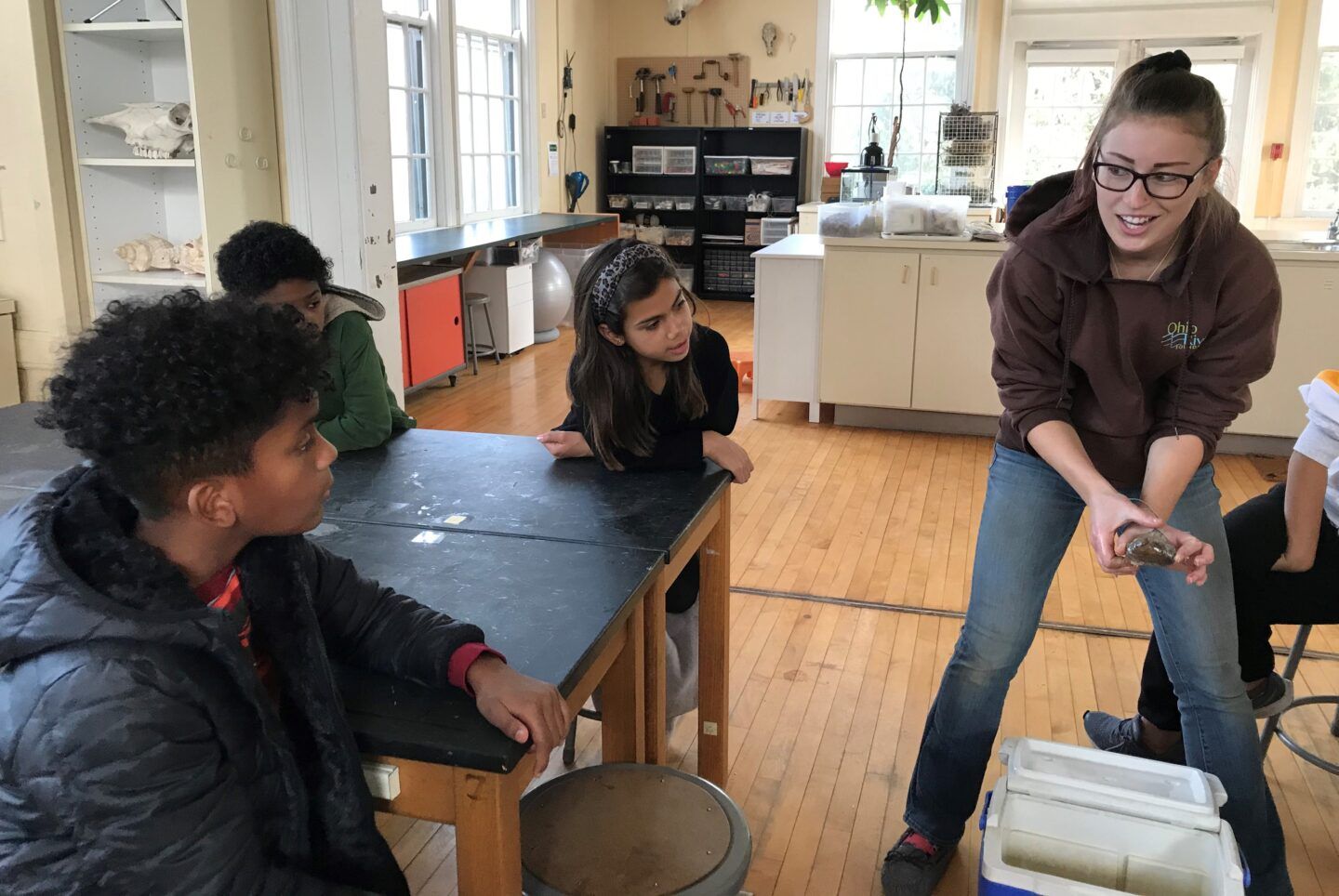
Students participating in Mussels in the Classroom (MIC) learn about the highly endangered freshwater mussels found in their local watershed and the hopeful conservation efforts working to protect them. MIC is an in-school, hands-on science program that makes topics like the basic needs of living things, life cycles, earth’s surface, species and reproduction, and biodiversity come alive in your classroom.
We bring live, native, freshwater mussels to your classroom as part of a 2-week-long adventure exploring conservation science happening in our community. For grades K-12. Offered in Greater Cincinnati.
Starting in the 2026/2027 school year, the MIC program fee will increase to $200 for the entire two-week program. This is an incredible value and can involve an unlimited number of students at your school.
What is Mussels in the Classroom?
Mussels in the Classroom strengthens real-world science connections and helps students better understand the complexity of aquatic environments. It’s also an important step in educating people about these overlooked and critically endangered species. Students will learn firsthand about threatened species living in waterways all around them and the conservation work being done in our community to ensure we don’t lose any more mussel species.
MIC kicks off with an in-person presentation provided by a knowledgeable educator (a pre-recorded option is also available). We bring live freshwater mussels, shells, and other items to deliver a 45-minute hands-on learning experience. Students learn about the importance of mussels to an ecosystem, their life cycle, and their current status in the environment. The educator leaves behind an aquarium and the necessary equipment for students and teachers to care for and monitor the mussels for a period of two weeks.
We provide the teachers with specific guidelines and protocols for the health and well-being of the mussels, as well as optional activities and lesson plans. Teachers and students may also create their own activities, which fosters creativity and scientific exploration.
While not a requirement, schools that have multiple classes participating in the program will receive preferential consideration.
All equipment (aquarium, water, food, aeration/pump, etc.), lesson plans, mussels, and supplies will be provided. The duration is two weeks.
Pricing: Only $200 for the entire two-week program!
A limited number of scholarships are available through our Rivers to Classrooms Education Access Fund.
The Scheduling Process
Apply online here. Programs are offered during the school year, Monday-Friday, during school hours only. Please provide several date options. We will review your request and get back to you in 3-5 business days.
We will schedule a date to come to your school to provide the in-person presentation and set up the tank of mussels. We will also provide a pre-recorded presentation which can be shared with any number of students and teachers at your school. The in-person presentation is 45 minutes long and is best suited for a maximum of 40 students.
Pricing: Only $200 for the entire two-week program!
A limited number of scholarships are available through our Rivers to Classrooms Education Access Fund.
We are happy to schedule multiple in-person presentations for an additional $100 fee per presentation. We can also provide additional tanks of mussels for an extra cost of $200 per additional tank.
Once you have scheduled your program, we will provide detailed information about the program and care requirements for the mussels.
Rivers to Classroom Education Access Fund
The Rivers to Classrooms Education Access Fund is a vital step toward leveling the playing field and ensuring every student has access to impactful nature-based, STEM programs.
Ohio River Foundation’s Rivers to Classroom Education Access Fund offers access to our two flagship programs, River Explorer field trip (4-12 grade) and Mussels in the Classroom (K-12 grade). It provides a limited number of River Explorer field trips for free (normally $8 per student) and a limited number of Mussels in the Classroom programs for $100 (normally $200 per program).
The Rivers to Classroom Education Access Fund provides free or discounted program fees only. For the River Explorer field trip transportation, meals, chaperones, etc. are not included and must be provided by the school.
Each year, funding availability is subject to change, and assistance is awarded based on need and a first come, first serve basis.
For the application you will need:
Proof of financial need: funds will only be awarded to schools with over 60% or more of the student population receiving free or reduced lunch. You must share your school’s percentage of students that qualify for free or reduced lunch.
Contact information: names, emails, and cell phone numbers of teachers attending.
Program information: estimated number of students, grade levels of students, and preferred program.
Apply for the Rivers to Classrooms Education Access Fund!
Next Generation Science Standards Alignment

Examples of Extension Activities
Freshwater Mussel Natural History
Most people don’t know what a freshwater mussel is. Prepare to be amazed by these very outrageous creatures that share the Ohio River Watershed with us.
Nature’s Best Disguise
Freshwater mussels play dress up and put on a tantalizing show using a part of their body evolved to look like fish prey called a lure. They are truly the superior anglers! They do this because mussels need a safe place for their baby mussels, or glochidia, to grow up. Mussels can’t get around very well with their false foot, or pseudopod, and they can’t provide a protective nursery space for their microscopic babies, so they outsource the job — essentially, they fool a fish into doing this for them.
When the fish is lured in close enough, the female mussel releases a cloud of baby mussels, which the fish sucks up into its gills, where those baby mussels clamp down and hold on for several weeks while they enjoy the oxygen, nutrients, and safety the fish unwittingly provides. Baby mussels spend the first few weeks of their life as parasites on specific host fish. Eventually, the baby mussels let go of the fish’s gills and fall to the bottom of the stream or river, where they carry out the rest of their lives.
Check out this video of a mussel exhibiting its lure and successfully tricking a bass.
Freshwater Filters
Mussels are filter feeders, which means they take water and everything in the water into their bodies via a siphon. They are looking for algae, bacteria, and other microorganisms to eat. If the water has a lot of dirt or sediment, mussels will help capture that and deposit it on the riverbed. They can also filter harmful pollutants out of the water. What comes out of the mussels’ outgoing siphon is super-filtered, clean water. They are like Brita filters living in our waterways. They can filter 10-20 gallons of water a day, removing harmful algae, bacteria, and even metals.
Saving our Biodiversity
Here in the Midwest, we are living in a mussel biodiversity hotspot for North America. Of the 297 species of mussels found in North America, 127 were once found in the Ohio River Basin. Sadly, today 70% of these species are extinct or endangered, making freshwater mussels the most threatened group of organisms in North America. This is due to many factors, primarily habitat loss, pollution, invasive species, and overharvesting in the early 20th century for button production as well as more recently for commercial pearl production.
The threats are real and daunting, but a passionate community of biologists, hobbyists, volunteers, and organizations like Ohio River Foundation (ORF), are determined to pull the remaining species back from the brink. ORF educates over 9,000 students per year on mussel conservation. Learn more about mussels.
More Info About Mussels
History of the Mussels in the Classroom Program
Introduced in the fall of 2017, our Mussels in the Classroom (MIC) program is available to K-12 students in Greater Cincinnati. This is the first classroom-based mussel education program in the U.S. (maybe the world!). It originated because of the increasing interest and work in repopulating rivers with native freshwater mussels. As agencies partnered with ORF in repatriating activities, there was interest in leveraging ORF’s education program expertise to involve students in a mussel education program.
We provide high-quality, accessible science programming to the Greater Cincinnati region, serving over 9,000 students and teachers per year. We have a proven track record of fun, engaging, and effective programming as evidenced by our ever-increasing participation numbers, excellent teacher feedback, and improved student science knowledge.
Teachers rate our programs at a 4.9 out of 5 in evaluations. Student knowledge of watershed ecology as measured in surveys administered before and after our programs show an average improvement of over 50%. We work with a wide range of partners to deliver cutting-edge science programming grounded in real-world conservation science. There is a tremendous need for quality, hands-on science programming, and we are working hard everyday to respond to this increasing demand.